When a design comes back wrong, the design usually isn’t what failed. The brief did. “Make it pop” and “I’ll know it when I see it” produce guesswork, and you pay for every guess, in revision rounds with a designer or in re-rolls with an AI.
Briefing is a learnable skill with a small set of moves, and the same moves work whether the designer is a human professional, a freelancer, or an AI tool. Here’s what goes in a brief, what deliberately stays out, and how to let references do the heavy lifting.
Why this matters
The brief is where a design project is won or lost, before any designing happens.
- Vague briefs bill by the revision. Each round of “closer, but not quite” costs days with a human and patience with an AI. Most revision cycles are the brief’s missing decisions being made one guess at a time.
- The designer can’t read the picture in your head. You’ve imagined a version of the result; they haven’t. A brief is the transfer mechanism, and words alone transfer style badly; references transfer it almost perfectly.
- AI raised the stakes on briefing. An AI produces exactly what you asked in seconds, which makes the gap between what you asked and what you meant instantly visible. Good briefing is now a daily skill, not a once-a-year one.
- Over-specifying fails as expensively as under-specifying. Dictate every color and margin and you’ve hired expertise you won’t let work. The skill is knowing which decisions are yours and which are theirs.
What a good brief contains
Six parts, whether it’s a logo, a flyer, a web page, or a social template.
1. The job, in one sentence.
What is this thing and what must it accomplish: “A yard sign readable from a moving car.” “A homepage that makes overwhelmed homeowners feel we’ll handle everything.” Purpose first; it’s the tiebreaker for every later decision.
2. The audience and the feeling.
Who sees it and what they should feel in the first second: premium and calm, friendly and local, bold and young. Two or three feeling words, consistent with your brand voice. If you’ve done your positioning work, this paragraph writes itself.
3. The fixed constraints.
The non-negotiables: exact brand colors as hex codes, fonts, logo files, required text and legal bits, sizes and formats, deadline, budget. Constraints aren’t rude; they’re the fence that keeps the work usable. A designer would rather know now than after round two.
4. References: three examples with reasons.
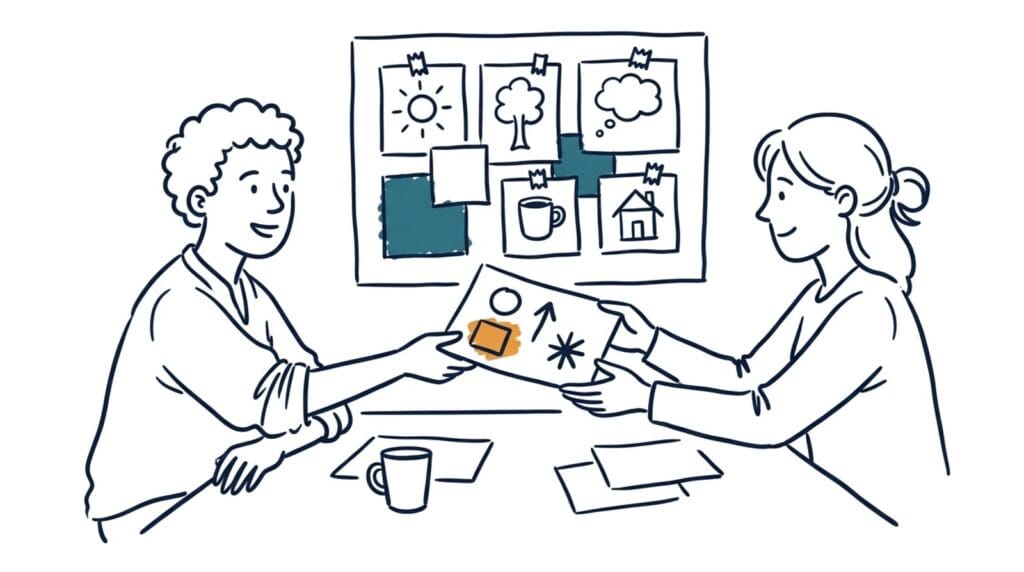
The highest-value section. Two or three designs you like, each with why: “this one’s spacing,” “how this one uses one color for the button.” Add one example you dislike, with why; a clear no is as directive as a yes. The reasons matter more than the pictures, because “like this because X” teaches taste while “like this” invites cloning. A small mood board, even a folder of screenshots, replaces a thousand adjectives. If you’ve chosen an imagery style, its style line belongs here verbatim.
5. What’s deliberately open.
Name the decisions you’re leaving to the designer: layout, type pairing, illustration approach, whatever their expertise covers better than your preference does. This is the line that turns a vendor into a collaborator, and it’s the one most briefs omit.
6. How you’ll judge it.
One sentence on what “done and good” means: “A stranger gets what we do in five seconds.” “I’d put this on a truck.” It gives the designer a test to check their own work against before showing you, which quietly deletes a revision round.
For an AI, the same six parts compress into a prompt: job, feeling, constraints, style reference language, and what to vary. The discipline transfers; only the length changes.
Putting it to work
- Write the brief before contacting anyone. Ten minutes with the prompt below, before the first conversation. Briefing on a call from memory is how “make it pop” happens.
- Collect references as you shop. Screenshot designs that stop you, into one folder, noting what caught you. A standing reference library makes every future brief a ten-minute job.
- State the open decisions out loud. Add the sentence “Layout and type are yours; colors and logo are fixed.” Watch the quality of what comes back rise.
- Give feedback against the brief, not against taste. “Section two: the feeling was calm; this reads busy” is actionable. “Hmm, not loving it” is another guess purchased. If the brief was silent on the thing you dislike, say so honestly; that’s a brief amendment, not a designer miss.
- Reuse the skeleton. The six parts don’t change across projects; only the answers do. Save your brief as a template and each new one gets faster.
One honest limit. A brief can’t supply judgment you haven’t formed. If you genuinely don’t know what you want, say that in the brief and buy exploration first: ask for three rough directions before anyone polishes anything. It’s cheaper to choose between sketches than to revise a finished design toward a preference you discovered late.
Take this prompt with you
Copy this into ChatGPT, Claude, or Gemini. It interviews you, then writes the brief two ways: one for a human designer, one as an AI prompt.
Interview me and then write a design brief.

The project: [what needs designing: logo, flyer, web page, sign, social template, etc.]

Ask me one question at a time, up to 8 questions, covering: what this design must accomplish; who sees it and what they should feel; my fixed constraints (brand colors as hex codes, fonts, logo, required text, sizes, deadline, budget); 2 or 3 designs I like and what specifically I like about each; one design I dislike and why; which decisions I'm leaving open to the designer's judgment; and how I'll judge the result.

If I answer vaguely (like "modern" or "clean"), push once with a concrete either/or question to pin down what I mean.

Then produce two versions:

1. DESIGNER BRIEF: a one-page brief with six sections: The job (one sentence) / Audience and feeling / Fixed constraints / References and reasons / Open to your judgment / How I'll judge it. Written so a freelancer could start without a follow-up call.

2. AI PROMPT: the same brief compressed into a single generation-ready prompt: subject, style and feeling language, constraints, and what to vary, ending with an instruction to produce 3 distinct directions.

Flag any contradiction between my feeling words and my constraints, and any place where I've over-specified something I said I'd leave open.