
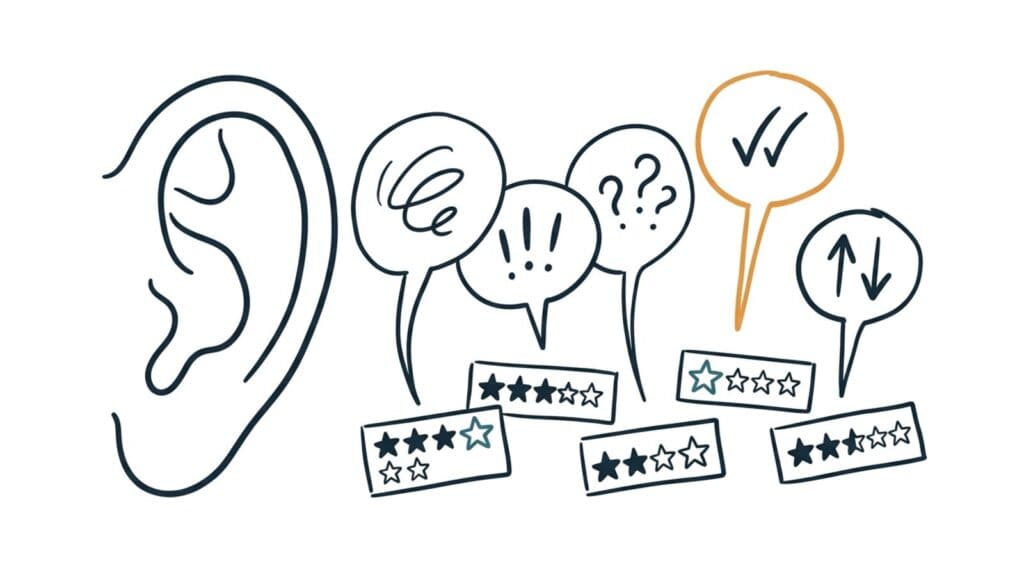
Your customers have already written your best marketing copy. It’s sitting in your reviews, and most businesses never read it that way.
Voice of the customer is a marketing term for a plain idea: collect the exact words real buyers use to talk about you, and write your marketing in their language instead of your own. Agencies run interviews and surveys to get it. You can get most of the way there with the reviews you already have and twenty minutes with an AI.
Why this matters
You describe your work from the inside. Your customers describe it from the outside. Those are different languages, and the outside one is the one that sells.
- You write in your words, not theirs. You say “comprehensive plumbing services.” The customer wrote “he showed up the same day and didn’t leave a mess.” One of those sentences books jobs.
- What you think customers value usually isn’t what they praise. Owners assume price drives the decision. Reviews say otherwise: they praise callbacks, punctuality, patience, and feeling taken seriously. You can’t fix a gap you’ve never seen written down.
- Familiar words earn trust before logic gets a vote. When your headline says the thing a buyer was already thinking, in the phrasing they’d use, you read as the safe choice. Copy that mirrors the reader always beats copy that impresses them.
The raw material for all of this is public, free, and sorted by star rating. It only needs to be read properly, and that’s the part AI is genuinely good at.
What your reviews already know
Read twenty reviews in a row and patterns appear that no single review shows. Four of them are worth mining.
1. The trigger.
What was happening right before they bought. “Our AC died in July.” “We’d outgrown the garage.” The trigger tells you the moment your marketing needs to meet, and the state of mind the buyer is in when they find you.
2. The worry.
What almost stopped them. “I’d been burned by a contractor before.” “I expected to be upsold.” Every worry that shows up twice belongs on your website, answered plainly, before the buyer has to ask.
3. The payoff.
What they actually praise afterward. It’s rarely the deliverable. It’s “they explained everything,” “no surprises on the bill,” “I didn’t have to chase them.” That’s what you’re really selling, and it should lead your copy.
4. The phrases.
The literal wording. Customers don’t say “responsive communication.” They say “he texted me back in ten minutes.” Collect these lines the way you’d collect testimonials, because they’re stronger than anything you’ll write from scratch.
Your competitors’ reviews hold the same four things about them. The complaints that repeat under a competitor’s name are unmet needs in your market, posted publicly, waiting for someone to answer them.
Putting it to work
- Collect at least 20 reviews. Google is the main source; add Yelp, Facebook, and any industry site that covers you. Fewer than 20 and the patterns aren’t trustworthy. If you’re short, add your competitors’ reviews and mine the market instead of the business.
- Copy the full text, not the stars. Paste the written reviews into one document. The one-line “Great service” reviews add little; the three-sentence stories carry the signal.
- Run the prompt below. It sorts the pile into triggers, worries, payoffs, and phrases, and pulls the quotes worth stealing.
- Read it for surprises. Anything that confirms what you already believed was already in your head. The finding that makes you wince, the worry you didn’t know buyers had, is the one that pays for the exercise.
- Put the words to work. Rewrite your homepage headline in a customer’s phrasing. Answer the top two worries on your services page. Hand the phrase list to whoever writes your ads, or paste it into your AI sessions alongside your brand voice guide.
One honest limit. Reviews skew toward the delighted and the furious, and twenty of them isn’t a research study. Treat what you find as strong hints to test, not settled fact. It’s still a better foundation than guessing, which is what most marketing is built on.
If you’re following this series, the findings slot straight into your positioning and customer profiles, and they’ll feed the marketing strategy you build next.
Take this prompt with you
Copy this into ChatGPT, Claude, or Gemini, then paste your reviews where indicated.
I run a [type of business] in [city or region]. Below are real customer reviews of my business [and my competitors' businesses, if included]. Analyze them as voice-of-the-customer research and give me:

1. Triggers. What was happening in the customer's life right before they bought? List the situations that pushed them to act, with a count of how often each appears.

2. Worries. What fears, doubts, or past bad experiences do reviewers mention, directly or between the lines? Rank them by how often they appear.

3. Payoffs. What do reviewers actually praise? Separate the work itself from how it felt to be a customer, and tell me which of the two they mention more.

4. Phrases. Quote 10 to 15 exact lines from the reviews that I could echo in my marketing. Pick the ones an ad writer would steal: vivid, specific, and in plain customer language.

5. Gaps. If competitor reviews are included, list the complaints that repeat about them, and tell me which ones my reviews show I already handle well. Those are my openings.

Then give me: my three strongest selling points in the customers' own words, and the two worries my website should answer on the first screen.

Quote reviews exactly. Don't paraphrase them into marketing language. If the reviews are too few or too thin to support a finding, say so instead of stretching.

[PASTE YOUR REVIEWS HERE]