
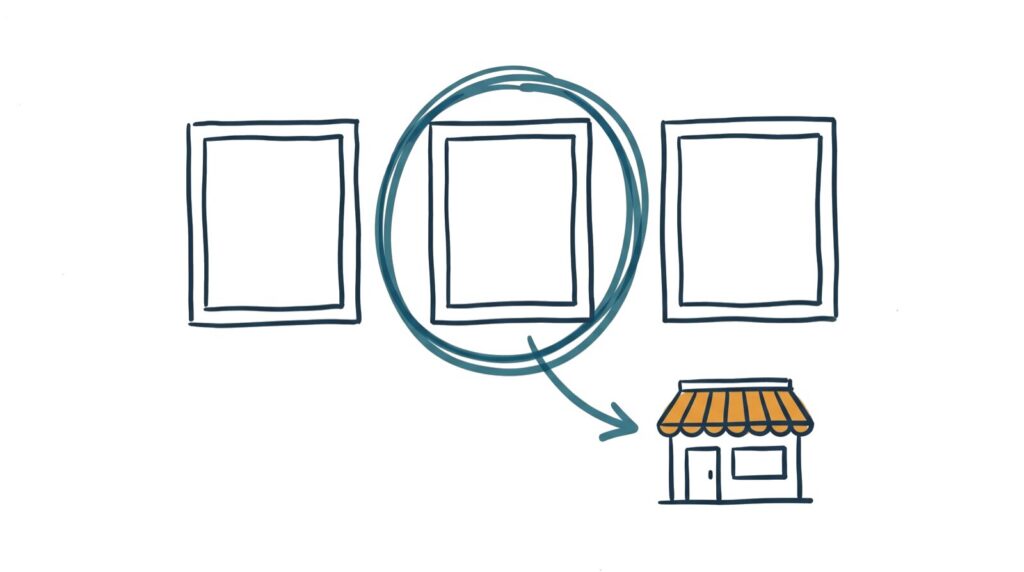
Three questions decide whether your marketing can work before any of it runs: who you sell to, what you sell them, and why they should pick you. Positioning and customer profiles are those answers, written down.
This is the shortest document in your marketing foundation and the one everything else leans on. Your website copy, your ads, your content topics, even your prices all inherit their direction from it.
Why this matters
Skip this document and the gaps show up everywhere else, wearing disguises:
- Marketing to everyone reaches no one. A message broad enough to exclude nobody is too vague to move anybody.
- Copy drifts to features instead of problems. Without a clear picture of the buyer, writing defaults to describing the business rather than the thing the customer is trying to fix.
- Price shopping is a positioning problem. When buyers can’t see a difference between you and the next option, price is the only thing left to compare.
- Every decision reopens the same argument. Should we be on Instagram? Should we write about X? Without a definition of who you serve, every choice is a debate from scratch.
What the document contains
1. Positioning: the one idea you want to own.
Positioning is the place your business occupies in a customer’s mind. Not a slogan, a decision. “The plumber who shows up when they said they would” is a position. “Quality plumbing services” is not, because nobody can own it and nobody remembers it.
Narrow beats broad. The more specific the claim, the easier it is to believe, to remember, and to repeat to a friend.
2. Customer profiles: two or three real buyers, described concretely.
A customer profile describes one kind of buyer as an actual person: their situation, the trigger that starts their search, what worries them before they commit, and how they decide. Two or three profiles, no more. Ten profiles is the same as none.
Skip the filler demographics. Age and income matter only when they’d change what you say or where you say it. The trigger and the worry almost always matter.
3. Why you: the honest reasons.
For each profile, why should this person choose you over their real alternatives? The alternatives include competitors, doing it themselves, and doing nothing at all. If the honest answer is thin, that’s worth knowing now, on paper, rather than discovering it in your results.
The test of a real position: it excludes someone. If no customer would ever read your positioning and think “that’s not for me,” you haven’t claimed anything yet.
Putting it to work
- Gather your inputs. Your industry analysis if you’ve run one, your reviews, and your own memory of your best customers: the ones you’d clone if you could.
- Run the prompt below. It interviews you, then drafts the positioning statement and profiles.
- Pressure-test the draft. Does each profile match at least one real customer you’ve served? Does the positioning exclude anyone? Would a competitor claim the exact opposite? If no competitor would ever say the opposite of your claim, the claim is empty.
- Write the one-sentence version. Put it at the top of the document. It becomes the first thing you paste into every future AI session, and the next article in this series turns it into a full marketing strategy.
One honest limit. AI can organize your answers and sharpen your language, and it’s genuinely good at both. But choosing who to serve is a business decision, not a writing task. The AI drafts it; you have to mean it.
Take this prompt with you
Copy this into ChatGPT, Claude, or Gemini and answer its questions one at a time.
Help me define my positioning and customer profiles. Interview me first: ask the following questions ONE AT A TIME and wait for each answer.

1. What do I sell, and in what area or market?
2. Think of my best past customers, the ones I'd clone if I could. Who were they and what did they hire me for?
3. Which customers turned out to be a bad fit, and why?
4. What do customers say when they thank me or refer me? Exact words if I remember them.
5. What are my customers' real alternatives? Include competitors, doing it themselves, and doing nothing.

Then produce a document, two pages maximum, with:
- A positioning statement in this form: For [who], [my business] is the [category] that [specific claim], because [proof]. Then a plain one-sentence version I could say out loud.
- Two or three customer profiles. For each: their situation, the trigger that starts their search, what worries them before they commit, how they choose a provider, and the single most persuasive thing I can say to them.
- A short 'not for' list: who we are happy to send elsewhere.
- Three honest reasons each profile should pick me over their alternatives. If my answers don't support three, say so and tell me what's missing.

Challenge me where my answers are vague. If my positioning could describe any competitor, push back and make me sharpen it.