
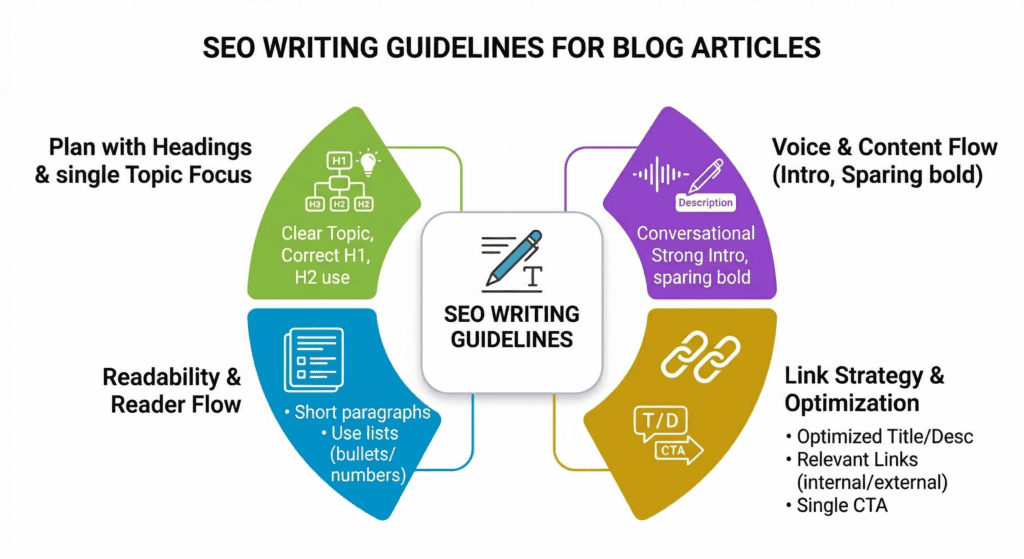
These guidelines will help you write blog articles that are easy to read, easy to publish, and perform well in search engines.
Think of this as writing for real people first, while also helping search engines understand what your article is about.
1. Article Structure
Use headings to organize your content clearly.
- Heading 1 (H1) → Article title (only one per article)
- Heading 2 (H2) → Main sections (use 2–4)
- Heading 3 (H3) → Sub-sections (optional)
Example structure:
- H1: Article Title
- H2: Main Section
- H2: Main Section
- H3: Sub-section (if needed)
Rules:
- Only one H1 (the title)
- Do not bold headings (they are already emphasized)
- Keep sections clear and easy to scan
2. Write for One Clear Topic
Each article should focus on one main topic or question.
Before writing, ask:
- What is the main thing this article is about?
- What would someone search to find this?
Use that topic naturally throughout the article:
- In the title
- In the introduction
- In at least one heading
- A few times in the body (don’t force it)
3. Strong Introduction (First Paragraph)
Start with a short intro that:
- Clearly explains what the article is about
- Tells the reader what they’ll learn
- Uses simple, direct language
Keep it to 2–4 sentences.
4. Keep Paragraphs Short and Readable
- 2–4 sentences per paragraph
- Avoid large blocks of text
- Use bullet points when helpful
Make it easy to scan.
5. Use Lists When Helpful
Bulleted or numbered lists:
- Improve readability
- Help break down steps or ideas
- Are great for summaries or tips
6. Links (Very Important)
Internal Links (to your own website)
- Include 1–3 links to other relevant pages on the website
- Link naturally within the text (not forced)
External Links (to trusted websites)
- Include 1–2 links to high-quality, non-competing websites (example: government, educational, or well-known sources)
Link Rules:
- Always test your links
- Do not use links that redirect
- Link directly to the final page
- Only links should be underlined
7. Title and Description
Every article needs both:
Title
- Clear and specific
- Includes the main topic
- Sounds natural (not robotic)
Description (Very Important)
- 1–2 sentences
- Under 160 characters
- Explains what the reader will learn
8. Use Bold Text Sparingly
- Use bold to highlight important phrases
- Do NOT bold headings
- Do NOT overuse bold (a few times per article is enough)
9. Images (If Included)
If you include images:
- Choose images that support the content
- Use clear, descriptive file names (example: tamarindo-beach-sunset.jpg)
- Add a short caption if helpful
10. End with One Clear Call to Action
Every article should end with:
- One clear next step
- One link
Do NOT give multiple choices.
Examples:
- Start your home search
- Contact us
- View available listings
Keep it simple and direct.
11. Tone and Style
- Write in a clear, conversational tone
- Avoid jargon or overly complex language
- Write like you’re explaining something to a client
12. Length Guidelines
- Aim for 800–1,500 words unless instructed otherwise
- Cover the topic fully, but don’t add fluff
13. Final Checklist Before Submitting
Before you submit your article, check:
- One H1 (title only)
- 2–4 H2 sections
- Clear introduction
- Short paragraphs
- Main topic used naturally
- 1–3 internal links
- 1–2 external links (non-competitors)
- All links tested (no redirects)
- Description under 160 characters
- No underlined text (except links)
- No bolded headings
- One clear call to action at the end